

Last Updated: March 6, 2026
The Grand Canyon is famous for its massive scale, dramatic cliffs, and seemingly endless views. But one question many visitors ask when standing on the rim is: how wide is the Grand Canyon at its widest point?
The answer might surprise you because the canyon’s width changes dramatically depending on where you measure it.
Short Answer
The Grand Canyon reaches its widest point at about 18 miles (29 kilometers) across from rim to rim. This maximum width occurs in several sections of Grand Canyon National Park, where erosion carved massive side canyons and plateaus between the North and South Rims.
However, most visitors standing at popular viewpoints see widths closer to 10 to 12 miles.
Long Answer
The Grand Canyon is enormous in every dimension. It stretches 277 miles long, is over a mile deep in many places, and varies widely in width along its length.
Because the canyon formed through millions of years of erosion by the Colorado River, its width changes constantly depending on the landscape and rock formations.
Key facts about the canyon’s width include:
- The maximum width is about 18 miles (29 km) from rim to rim.
- The average width is roughly 10 miles (16 km).
- In narrower sections, the canyon can be less than 5 miles wide.
- The canyon extends 277 miles across northern Arizona.
These numbers make the Grand Canyon one of the largest and most complex canyon systems on Earth.
Where Is the Grand Canyon Widest?
The widest sections of the Grand Canyon typically occur in the central and eastern areas of the national park, where erosion has carved massive branching side canyons.
Unlike narrow slot canyons, the Grand Canyon spreads outward with huge terraces, mesas, and plateaus between the rims.
Several geological features contribute to the canyon’s extreme width:
- Large side canyons carved by tributary rivers
- Massive rock layers that erode at different rates
- Millions of years of uplift of the Colorado Plateau
- Continuous erosion by wind, water, and gravity
These forces created the enormous open landscape visitors see today.
In the widest sections, the canyon becomes so broad that the opposite rim can appear hazy or distant, especially on hot days.
Why the Grand Canyon Is So Wide
The Grand Canyon did not simply form as a narrow crack in the ground. Instead, it developed through a long and complex geological process that gradually widened the canyon over time.
Scientists believe the Colorado River began carving the canyon around 5–6 million years ago, although some rock formations inside the canyon are nearly 2 billion years old.
Over millions of years:
- The Colorado River cut downward through rock layers
- Rain, flash floods, and tributary streams carved side canyons
- Rockfalls and landslides widened the canyon walls
- Erosion gradually expanded the canyon outward
This combination of vertical erosion and horizontal expansion is what created the canyon’s incredible width.
The result is a landscape so vast that from many viewpoints, the canyon appears more like a massive mountain range turned inside out rather than a traditional canyon.
How Wide the Canyon Feels From the Rim
Even though the canyon’s widest point reaches 18 miles, most visitors experience slightly smaller distances between the rims.
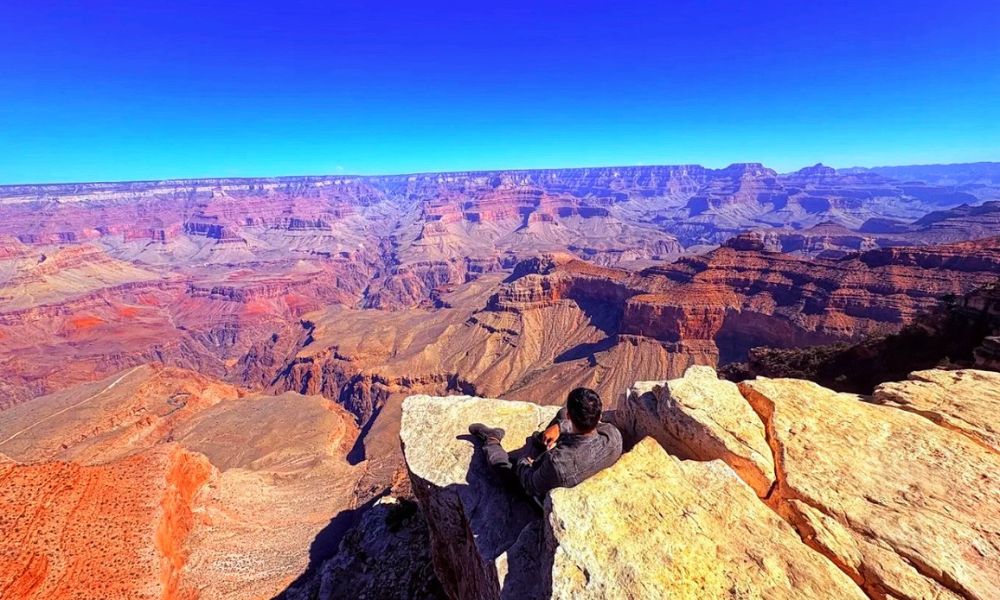
At popular viewpoints on the South Rim, the canyon typically appears 10–12 miles wide. This is still an enormous distance, especially when you realize the canyon also drops more than a mile deep.
From many viewpoints, the opposite rim can look surprisingly close because the canyon contains multiple layers and terraces between the edges.
To understand the scale, consider this:
- If you drove 18 miles, it would take about 30 minutes at city speeds.
- Hiking across the canyon rim-to-rim requires over 20 miles of trail.
- The canyon’s width can vary by more than 10 miles depending on the location.
This is why the Grand Canyon often feels impossible to photograph accurately. Cameras struggle to capture its full scale.
Experiencing the Canyon’s Full Scale
The best way to appreciate the canyon’s width is to see it from multiple perspectives.
Visitors experience the canyon’s immense scale in several ways:
- Standing at South Rim viewpoints like Mather Point or Desert View
- Visiting the North Rim, which sits about 1,000 feet higher
- Flying above the canyon on helicopter or airplane tours
- Rafting through the canyon along the Colorado River
Many travelers visiting Nevada choose to explore the canyon through Grand Canyon tours from Las Vegas, which allow visitors to experience the canyon’s massive scale without planning a long road trip.
From the air, the canyon’s width becomes even more obvious. The landscape stretches across the horizon with layers of mesas, buttes, and cliffs.
Bottom Line
So, how wide is the Grand Canyon at its widest point?
The canyon reaches about 18 miles (29 kilometers) across from rim to rim at its widest sections. However, the width varies greatly along the canyon’s 277-mile length, with many viewpoints showing distances closer to 10–12 miles.
Combined with depths exceeding one mile, this incredible width is part of what makes the Grand Canyon one of the most awe-inspiring landscapes on Earth. Its vast scale, layered geology, and dramatic viewpoints continue to attract millions of visitors every year.